Details
The Details view provides an Explorer-like list of files and folders that are contained in the current selected item in the Directory Tree. Detailed information on each file or folder can be shown by selecting the desired attribute in the column list, available by right-clicking the header of the list or via the Details page in the options dialog of SpaceObServer.
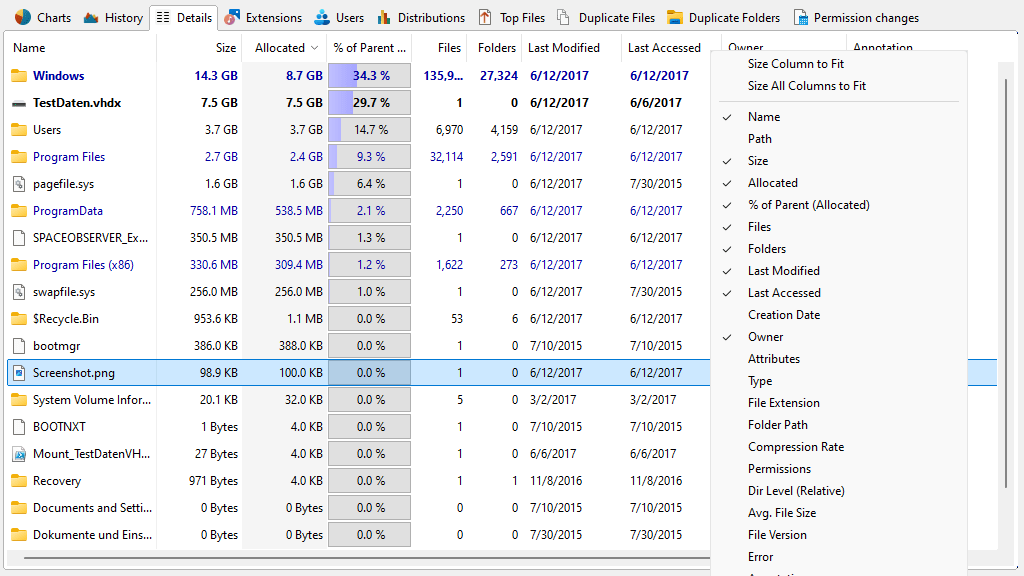
Context tab: Details
Like every view in SpaceObServer, the “Details” view comes with a Ribbon tab that is activated when the list is clicked. The Ribbon tab provides commonly used list functions such as select operations or export features.

The following commands are available on the “Details” tab:
Delete Deletes the selected items. Hold the “Shift” key to remove the item(s) from the disk permanently (Please note: You cannot recover files that have been removed permanently!).
Properties Shows the properties for the selected item.
Move items Opens a new dialog with enhanced features to move, delete, archive etc… the selected/checked items.
Export Details Exports the contents of the list to a file. If two or more items are selected, only the selected items will be exported. Available file formats are “Microsoft Excel Files (.xlsx)”, “Text Files (.txt)”, “HTML Files (.html)”, “CSV (Comma Separated Values) Files (.csv)”, and “PDF Files (.pdf)”.
Send List Sends the content of the list via email.
Copy List Exports the contents of the list to the clipboard. If two or more items are selected, only the selected items will be exported.
Print right pane Prints the selected items of the list.
Select all Selects all items in the list.
Select none Unselects the list items.
Invert selection Inverts the selection.
Show Checkboxes Toggles the visualization of checkboxes in the “Details” list and in the Directory Tree.
Check Selected Items Checks the currently selected list items.
Uncheck Selected Items Unchecks the currently selected list items.
Edit Annotation Lets you edit the annotation of the currently selected list items.
Open Containing Folder Opens the containing folder of the currently selected list items.
Apply NTFS Compression Compresses the currently selected list items using NTFS compression.
Open command prompt Opens command prompt at the current directory of the list.
Decompress Turns off NTFS compression for the currently selected list items.
Copy File Name Copies the name of the currently selected list item to the clipboard.
Show Details Flat Toggles whether the files of all subfolders should be displayed in the “Details” view.
Show File Preview Toggles if a preview of the selected list item should be displayed on the right of the “Details” view.
Context Menu on the Details view The list on the Details view shows the Windows Explorer context menu when you right-click on an item. An additional submenu labeled SpaceObServer is included which shows all information that is available about the selected item.
Bulk renamer
This dialog allows renaming multiple files at once, using one of several types of rules.
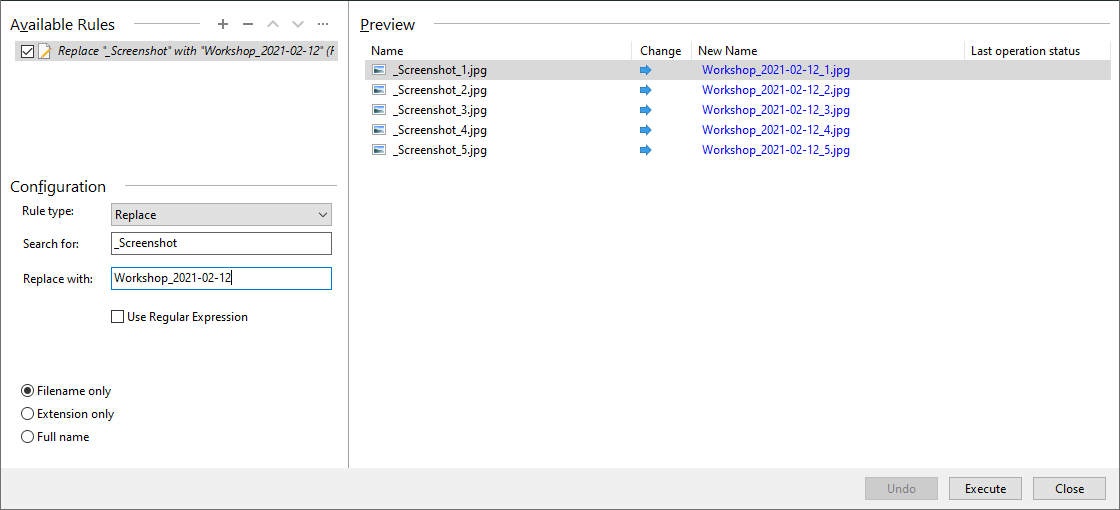
To define a new renaming rule, click the “+” Icon and select one of the available rule types. The section “Available Rules” shows all rules that have previously been created. Each rule can be activated or deactivated individually and will be applied in the order that they are displayed in. You can reorder existing rulesets by using the icons on top of the list, or by simply dragging and dropping them within the list of available rules. Existing rules can be modified by selecting them. Changes to their configuration will be applied to the preview section immediately.
The right hand side show a preview of the current ruleset. It shows the file names before and after the rename operation and provides a quick overview of whether or not the filename will change or remain the same after the operation.
Available Rules
This list shows all previously created renaming rules. The rename operation will be applied in the order of this list. To change the order that the rules are applied in, simply drag and drop the rules to their designated position within the renaming chain. You can also use the right click menu to move the current selection up, or down in the list.
Existing rules can be temporarily disabled via the left hand checkboxes. Only active rules will be regarded in the actual renaming operation
Replace A simple search and replace operation for file names. Under “Configuration”, you can enter the search term to search and what to replace it with. Activate the option “Use Regular Expression”, if the input term should be interpreted as a regular expression, instead of an exact match. Further information about regular expressions can be found here.
Insert Inserts the given text to the file name at the position that is defined under “Configuration”. The text can be appended as prefix, as suffix, or at a specific position.
Serialize Adds a number to the files, starting with the value that is defined under “Configuration”. The number can be added as prefix, as suffix, or at a specific position. It is also possible to unify the numbering to a minimum length. Check the option “Pad to length”, in order fill up numbers with leading “0”s and ensure a unified length.
Delete The delete rule has two options: Search and removes a certain text, or delete text at a certain position within the target file names. “Delete text” will remove all occurrences of a given search term. “Delete from position” will remove text at a given position within the target file names. Use “Length” to define how many characters should be removed.
The selection “Filename”, “Extension only”, “Full Name” determines which part of the file name should be affected by the rename operation. This selection can be configured for each rule individually.
Preview
This panel shows a preview of the rename operation with the current selection of active renaming rules. The column “Name” shows the original file name, while “New Name” shows a preview of the names as they would be after the rename operation. The “Change” column shows at one glance which names will change and which will remain the same. The column “Last operation status” will show whether or not the last renaming of a file was successful, after the operation has finished. If a file could not be renamed successfully, e.g. due to missing permissions, it will be shown in this column.
Execute
Starts the actual rename operation. All active rules will be applied to the files on the right hand side, one after another. Once the operation has finished, the status is shown in the column “Last operation status” of the preview list.
Undo
Reverts the last renaming operation back to its previous state. This effectively means that another rename operation is triggered that renames the files back to their original name.