Search paths
The bar “Search in:” above the result list defines which drives and paths the file search starts from. Every search target is shown as a separate tile, so you can see all of them at a glance and work on a single one without touching the others. The tiles are sorted alphabetically, so a target always stands in the same place, no matter how it entered the bar.
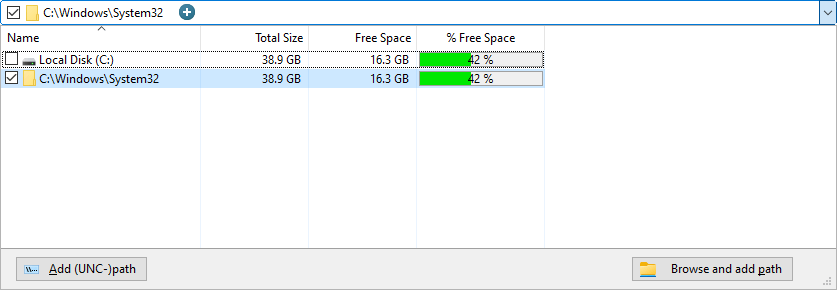
You can reach the bar from anywhere in the window with Alt + I.
Working with the search targets
Each tile stands for one search target and offers two controls:
Check box: Determines whether this target is included in the next search. Unchecking a target keeps it in the bar, so you can leave it out of one search without having to enter it again later. If several tiles are selected, the check box changes all of them in one step.
Remove button: The round button inside the tile removes this target from the bar.
Clicking a tile selects it – it neither starts a search nor opens the tile for editing. This is the same behavior as in the Windows Explorer, and it lets you work on several targets at once:
Ctrl+ click adds a tile to the selection or removes it from it.Shift+ click extends the selection up to the tile you click.Ctrl+Aselects all tiles.
Del removes all selected targets in one step. To change the path of a single target, select the tile and press F2. A path you change is sorted in under its new name, and TreeSize moves the focus to wherever it ended up – including into the pop-up at the end of the bar, should it no longer fit there.
Note
If there is not enough room for all tiles, the remaining ones move into a small pop-up that you can open at the end of the bar. Selection, editing and removing work there exactly as they do in the bar itself.
Adding search targets
There are three ways to add a target:
Type it in: Click the empty area of the bar and enter a path. While you type, a drop-down suggests matching paths from your search history.
The plus button: Opens the scan target dialog, which assembles even complex paths and URLs for you. The keyboard shortcut is
Ctrl++.The drop-down: Pick a path you have used before, one of your favorites, or a drive – see the next section.
The file search supports the same Scan Targets as the main module of TreeSize, including WebDAV, Amazon S3, and SSH.
The drop-down: search history, favorites and drives
Open the drop-down with Arrow Down or Alt + Arrow Down. It shows three groups, each under a heading of its own:
Favorites – the paths you marked, in the order in which you marked them.
Search history – the paths you used most recently, the newest one first. This group is limited to a few entries so that the drop-down stays short; the complete search history is available on the page Search history.
Drives – all drives with their free disk space, for example “433 GB free of 952 GB”, followed by the cloud folders that are synchronized to this PC.
A group without entries is left out together with its heading. While you type, the list shows the matching paths only, without the headings.
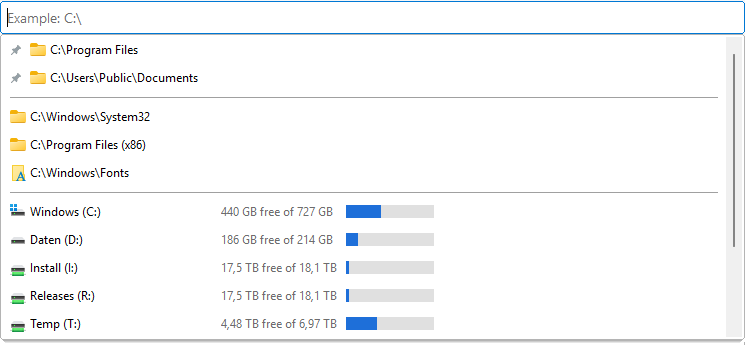
Selecting an entry adds it to the bar as a new tile.
Note
A path enters the search history only once a search has actually been run with it. Entering a path and then changing your mind therefore leaves no trace in the list.
Marking favorites
Favorites are paths that always stay at the top of the drop-down, no matter how long ago you used them last. Point at a row to show its pin symbol on the left and click it to add the path to your favorites or to remove it from them again. Favorites are never dropped from the list when the search history grows.
Targets that cannot be reached
TreeSize checks in the background whether the paths it offers can currently be reached. A path that does not answer is marked with a small grey cross over its icon and its caption is greyed out; in the drop-down and on the page Search history its tooltip also reads “Currently not reachable.”. Network drives that Windows reports as disconnected are shown with the corresponding Windows symbol.
The mark appears on the tiles of the bar as well – on folders and on share roots like \\SERVER\Share, while a drive letter carries the Windows symbol instead. The tiles are checked again each time you turn to the bar, and a mark that is up stays up until the next check answers, so a tile can carry it for a while after the share has come back.
Marked entries and tiles stay selectable and stay in the search – a share may well be available again by the time the search starts.
Keyboard
Key |
Function |
|---|---|
|
Puts the focus into the bar “Search in:”. No tile is selected then, so |
|
The bar holds two tab stops: the bar itself, and the tiles in it. The next |
|
Walks the bar as a single row: from the bar into the first tile, on through the tiles, then onto the plus button and finally onto the button that opens the pop-up of the tiles that did not fit. |
|
Opens the drop-down, with no entry marked yet: either start typing right away – the input field is fully selected – or step into the list with a further |
|
Opens the scan target dialog to add a further target. |
|
Opens the focused tile for editing. Plain |
|
Removes the selected targets. |
|
Toggles the check box of the focused tile – and of every other tile selected with it. |
|
Adds the focused tile to the selection or removes it from it. |
|
Jumps to the first or last tile, together with |
|
Closes the pop-up at the end of the bar and puts the focus back on the button that opens it. |
Inside the drop-down the following keys apply:
Key |
Function |
|---|---|
|
Moves through the list. This also works while the focus is still in the input field, so you can keep typing at any time. Together with |
|
Applies the marked entries, just like a double click does. |
|
Adds the current path to your favorites or removes it from them. While the focus is still in the input field, use |
|
Steps from the row onto its pin symbol, where |
|
Closes the drop-down without changing the search targets. |
Note
You can search entire servers or PCs by using their UNC name like \\SERVER.
You can even search you entire network by choosing the network neighborhood of Windows in the directory browser appearing after pressing Browse and Add Path.
TreeSize automatically browses for PCs and all shares on them (including hidden shares) and performs the search on all shares it finds.